1kz Te Cylinder Head Crack Detector
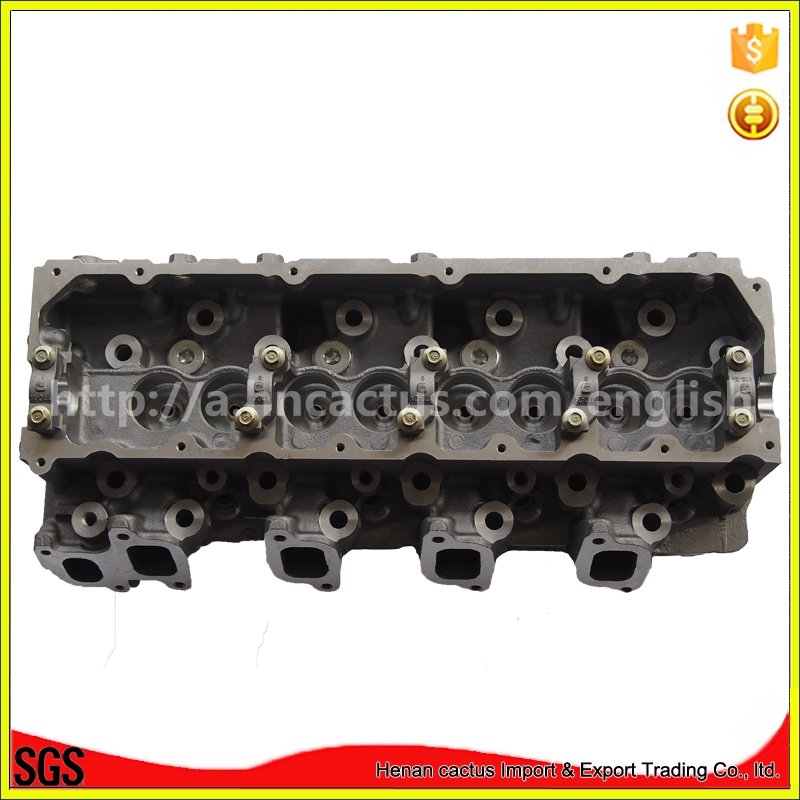
You are right, never buy chinese copy. I did that, it lasted only 4 months/6500 km! All heads are made of aluminium. Then I bought oem Toyota head from Steve OBrien, Engine Company Services Ltd: Complete original Toyota head with Toyota head gasket (complete kit with recycled camshaft/valves, included bolts and other gaskets) was £899 about 1,5 years ago. I had to send the old camshaft and valves to them. What I have heard and understood, AMC heads are even better than original.
You can get those from Roughtrax. Click to expand.When I had my cracked head last year with the old radiator I would use up water every time the engine runs and I would see the temp gauge moving when going up hills and towing. I have had this cracked hear for nearly 3 years now.
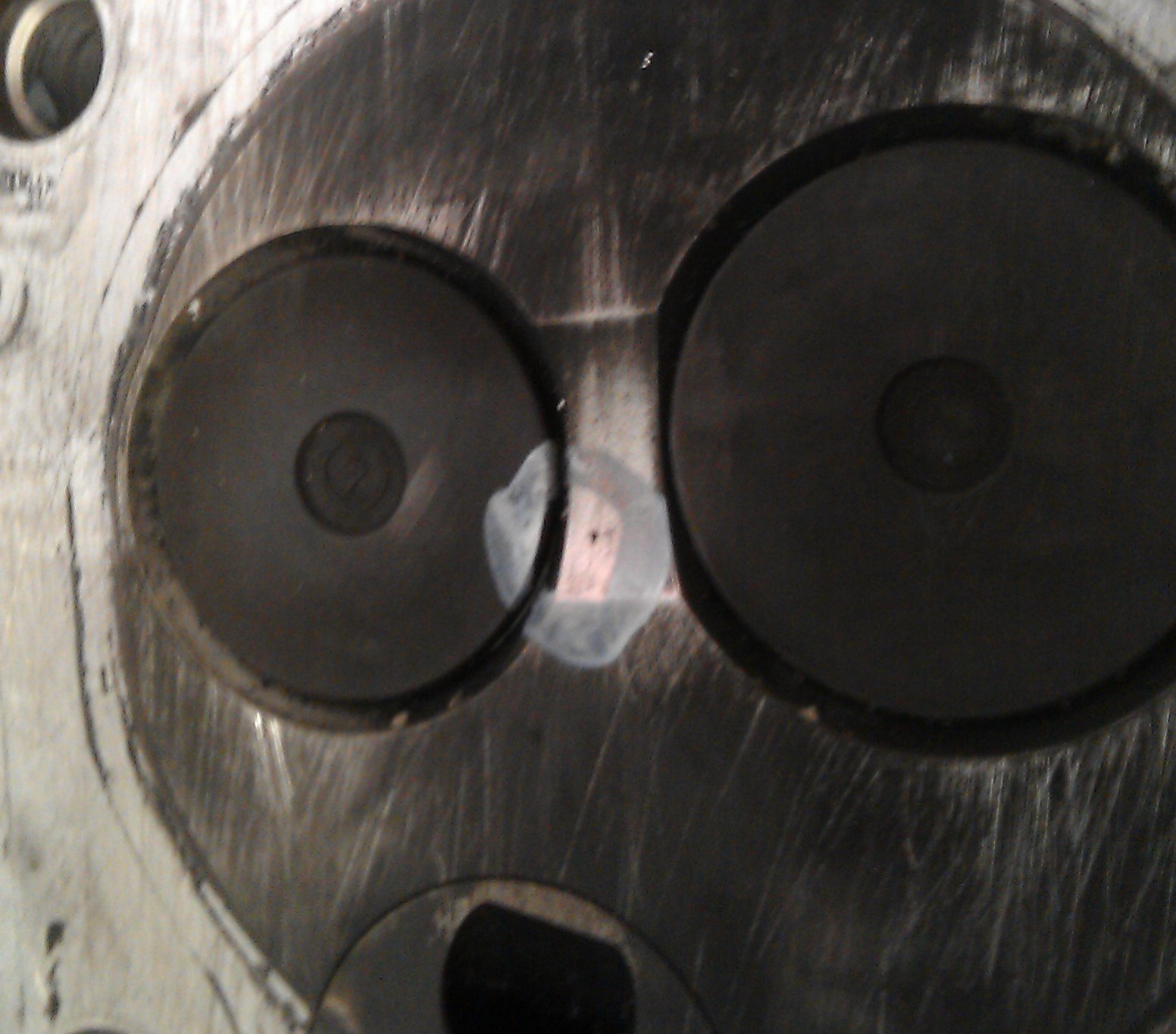
Sep 22, 2011 See parts 2 & 3 for how it worked.i was told it was that bad it couldnt even be alloy welded, I know for a fact the crack is about 10mm long and around 1.
Last year I replaced the radiator and it does not use up any water when running around, only when towing and pushing it hard on the motorway. When I replace this head, I will put a Intercooler in and maybe a second temp gauge to help monitor the temperature.
So would you reccomend a chinease one or should I stick with roughtrax? Hi, I replaced mine with an AMC unit from Roughtrax. I bought the 'ready-to-fit' option with the cam and valves fitted and shimmed. The head has been fine, but I used a pattern gasket which leaked soon after fitting. This Spring I replaced the gasket with a genuine Toyota one (and used jointing compound in case there was a low spot somewhere) and have had no trouble since. I also replaced the radiator, water pump and put a 76deg thermostat in. Its been fine towing a double horse trailer with two large horses since then.
1kz t head gaskets leaking?? Jaronimo, I'm not sure that I understand all this..
You have an 80deg thermostat in the top and a modified thermostat in the bottom, how has the lower 'stat been modified?? On the standard set-up there is no restriction to the flow at the top and the lower 'stat is 82deg C. The problem seems to be that the top gets too hot under sudden loads and the bottom doesn't get hot enough to open the 'stat. With the lower 'stat closed, the coolant can circulate around the block. With the lower stat open the flow from the bottom of the block is stopped and coolant circulates from the bottom of the radiator, past the oil cooler (hidden behind the oil filter) around the head and out of the top to the radiator.
Presumably the system relies on thermosyphon to let cool coolant replace hot coolant at the bottom of the block. If your lower 'stat is stopping the flow from the radiator, your top 80deg C 'stat won't make any difference as it will open way before the lower one.
I'd be inclined to put a 76deg C 'stat in the bottom - but I think the top stat will still be redundant - unless, of course, you have done something clever to the lower 'stat. I await an explanation with interest!
I thought this was helpfull, Diagnosis of KZ-TE. Schemes of connecting sensors and actuators to the engine control unit (ECU).
Repairs The hands Although rarely, yet sometimes there is a problem with the engine electronics failure 1KZ-TE. Which leads to the light bulb lighting up on the instrument panel, the CHECK ENGINE, and sometimes quite impossible to start the engine.
Often it is something to do with a long downtime technology, soggy electronics, deterioration of contacts in a relay or connectors and wires. The first resort to anything - check the fuses, then attempt to verify the vibration method of connectors, wires and relays in electronics box.
It takes just check the voltage of the battery and its connections, the quality of the terminals, pay close attention to the wire and fixings to the body mass, the engine. If the items listed above are normal, start diagnosis. Just make a reservation, documentation and diagrams precisely Haisu I do not, I use the circuit from under the instruction 1kZ-TE. Tying, respectively, if they will be different, it is insignificant, mainly - controlled glow plugs and, perhaps, a slightly different name of the relay and fuse, but the principle is the basis laid down the same signals and the same. Review your I prepared the material, which is available here: I'll start with the color-coded wires.
B (black) - black; L (blue) - Blue; R (red) - red; BR (brown) - brown; LG (light green) - c willow-green; V (violet) - Purple; G (green) - green; About ( orange ) - orange; the W ( Communities white ) - white; the GR ( gray ) - gray; the P ( pink ) - pink; the Y ( yellow ) - yellow. When you specify a two-color combinations with a hyphen - in this case, the first light - color wires, the second indicator - color applied over the first strip (for example, the BR stands for black with a red stripe) Because occur in practice, cases when the assembly constructors, or after repairs, torn connectors not bolted (soldered). In most cases, according to statistics, suffer from signal wiring in the place of installation, removal of a starter. Now consider the 'tying' of the engine 1KZ-TE, sensors, actuators, signal circuits, the power supply circuit of engine management (ECM). Connection to a computer the crankshaft position sensor (signal to the TDC ) and the engine speed sensor (in fact, the engine speed is calculated in the computer on the momentum NE sensor on the pump). The waveforms TDC and pulses the NE. From the waveform in the figure we see the TDC unit impulse, this impulse is induced in the coil sensor crankshaft position during the passage of the TDC of the first cylinder and shows made one revolution of the crankshaft.
NE pulses induced in the coil of the gauge of turns on the pump from the gear that has teeth pass. Incoming information is analyzed in the computer and synchronizes modes pump and motor. Thus, in case of interruption or short-circuit wires to the sensor position of the crankshaft or a speed sensor, the sensor fault itself or open the input circuits in the computer unit, the engine control unit generates an error, respectively, 12 or 13. Another one interesting case, we told forumchanin Artem, he had a problem with the connector on the sensor position of the crankshaft, wire rotted and had to rebuild the connector, when the works were accidentally reversed polarity switching of the sensor, resulting in a form of pulse signal TDC has changed a bit and shifted over time. What after the warm-up and on the move led to an error to fire the CHECK ENGINE. ECU unit was trying to adjust the injection time, acting on a valve the TCV, but apparently, adjust injection timing angle is not enough. Sometimes erratic correction injection timing and to fire CHECK bulb causes bad tightening pulley pump, formed as a result of backlash and the key broke shponpaz course readings and sensor rotation of the injection rate became unpredictable.
Correction of the injection angle to fail with an error code 14. It happens - the plant is normal, but in the process sometimes there were failures, something klatsat, engine stalling, there was no error codes, it turned out - was slack wires from the crankshaft position sensor, insulation peretёrlas on rotating front propeller shaft to the ECU result, according incorrect data, trying to adjust the angle of the injection, the TCV solenoid chattering, responsible for the injection angle. Another case was when the positive lead trying to apply something on sensors, not knowing what they do and what it may lead, in the end was a fatal RPM sensor error (error 13) at the operating sensor and wiring. On opening the computer found that burned mass conductor on the circuit board.
There are options to Break connectors Korotyaev engine weight dangling from sockets - conductors - so if you repeatedly knocks EFI fuse - look in the engine compartment and check the active electronic harness on the engine - especially pay attention to the actuators - electric vacuum valves ( STH1 / 2, E-VRV), devices with the reference voltage + 5V (PIM, TPS), as well as SPV chain, TCV. Driving connection valve installation angle of injection at the fuel pump to the conclusion TCV ECU. Signal shape the TCV. Resistance -solenoid valve installation angle of injection should be 10-14 ohms at an ambient temperature +20'C, measured by an ohmmeter to the sensor contacts, when disconnected from the computer unit connector.
At discrepancy of the resistance of the solenoid - replace valve TCV. The same valve can be checked by submitting to him a short time (less than 30 seconds! ) Voltage of 12 volts (+12V on the output Bed and +, a lot of the withdrawal TCV solenoid ) must be clear audible clicks. But even they do not indicate that there is no jamming in the core, which reduces the range of automatic adjustment of the angle of injection and to fire CHECK lamp (14 error) in certain modes of engine operation. In this case, it helps the replacement or cleaning of the valve installation angle of injection. There are times when the carriage with rollers podzakusyvaet inside the pump housing due to scuffing or sticking fuel impurities, and does not give proper injection angle change during a working automation. If TCV valve clicks and faulty wiring and transition connectors to the computer unit prozvanivatsya and normal, de-energizes the car by removing the positive terminal of the battery, take out the unit ECU and to understand it - look chain (track) TCV signal and its elements.
When current flows through the coil, the stator core by the electromagnetic field, retracts the movable rod, compressing the return spring to open the fuel passage connecting the high and low pressure chamber. The greater the value of the exposure control current to the coil TCV valve, the wider opens a passage between the chambers. Thus, the timer piston is moved to the right by adjusting the fuel injection timing. Also noticed that in the case of pressure reduction in fuel injection pump housing in a pressure chamber upstream of the control rod TCV, fuel injection timing adjustment is small, so that the same will result in lighting up CHECK - 14. Reducing the pressure error can be caused by damage to or clogging of the fuel highway fuel zagelivaniem scored fuel filter and other obstacles to normal fuel passage (filters and filtriki on the pump set by the additional filter on the fuel line). Temperature sensor connection diagram ( THW is ) coolant to the ECU. When checking sensor in accordance with the diagram, its resistance value at a specific temperature must meet the tolerance range.
Temperature sensor connection diagram ( the TH A ) of air in the intake system to the computer. When checking sensor in accordance with the diagram, its resistance value at a specific temperature must meet the tolerance range.
Connection to a computer unit correcting resistors. Corrective resistors typically do not change, and are supplied matched to this high-pressure fuel system. Wiring the pressure sensor in the intake manifold to the computer unit. A plot of the voltage at the output signal PIM on the pressure in the intake manifold. At pin 3 of pressure sensor in the intake should be about 4,5.5 voltage Volt. Measurements made with respect to weight, or one contact pressure sensor. Driving fuel temperature sensor is connected, set the side of the cast-iron head pump to the ECU.
When checking sensor in accordance with the diagram, its resistance value at a specific temperature must meet the tolerance range. Wiring the throttle position sensor ( the TPS ) to the computer, as well as verification method.
To learn how to remove the throttle for the prevention ofor test described. Driving the signal from the vehicle speed sensor, through a combination of instruments to the ECU.
Wiring starter feed circuit and command START on the computer unit. Connect the power circuit to +12 V computer memory block chain. Wiring ignition supply to the conclusion ( IGSW ) ECU unit, as well as control output ( MREL ) ECU unit and energizing the main circuits of the control unit ECU through the contacts ECD -rele to output + the BG ECU. Wiring contacts TE 1, TE 2 and E 1 of the diagnostic connector to the computer. Wiring the relay bypass valve ( Spill the Control Valve's the Relay ) and the overflow valve ( SPILL the Control Valve's ) to the engine control unit (ECU). Waveform SPV and signal comparison chart SPV, pulses NE from the engine speed sensor, to lift the needle and angle of injection of fuel.
On ostsillograme SPV signal measured at idle on the weight, you can see the moments when the metering valve (Spill control valve) is in the open and closed states. At idle the closed condition of the valve is approximately 10 ms. At about 3000 rpm, the closed state of the valve is changed to 3 ms. Color-coded terminals winding relief valve SPV (Spill Control Valve). And now look at the pieces of wire power supply to the engine control unit (ECU) is a minibus TOYOTA HiAce KZH106. Unfortunately, I can not yet give the pinout exact to connect signals to the computer, because the names of the chains is featured only the names of pins, the signal wires, it is, if necessary, one has to adjust itself, or in extreme cases to compare the findings - to connect to the valves, Spanish The mechanism and sensors. (I think in the spring by the example of his native haysika pinout unit ECU zasnimu and sign).
The figure shows how the ECU unit is energized, the relay and the bypass valve. In general, to start the engine with the computer unit is enough to connect the crankshaft position sensor ( the TDC signal ) and sensor speed to pump (engine speed ( the NE pulses )) to the computer, apply weight to the contacts E1, E01, E02 ECU submit the conclusions of the BATT, IGSW, ECU unit +12 V, check the appearance of the negative control signal SVR (takes a lot of control with a computer on one of the conclusions of the overflow valve relay coil the SPV ). Check the power supply +12 V to pin + B ECU unit. Checking appearance of the same control voltage of + 12V at terminal MREL, which in turn feeds one of the terminals of the winding of the main motor relay ( MAIN ), a second terminal of the relay winding is connected to MAIN weight. When unwinding the starter motor to start the computer unit itself, and thus the engine - need to apply for short-term output of the STA (this conclusion is usually torn when installing alarm with immobilizer) of the order of + 6.12 volts, as well as ensure that at terminal NSW ECU unit was a low level of about 0.3 V to allow the engine is started with the neutral or park. Further, with the successful start-up and remove the engine output voltage with the STA.
There was also the case when the motor is started, but stopped when removing the voltage from the STA output, it is connected with longer pulse applied to the bypass SPV valve at the time of start-up (the culprit was a faulty or misaligned valve cutoff SPV, its replacement has yielded positive results). You can further simplify things at the time of detection performance computer unit and start the engine by connecting the ECU control circuit without relay. Post contact mass by E1, E01, E02.
Post +12 volts on BATT, IGSW, + B, the bypass valve SPV, according to its polarity, connect respectively with one side to +12 volts, and the other to the contact SPV computer unit. Connect the crankshaft position sensor ( the TDC signal ) and speed sensor on the high pressure pump ( the NE pulses ) to the computer. Spinning the starter motor to start the engine to apply briefly + 6.12V for withdrawal STA ECU unit, making sure that the chain Start inhibit - contact NSW energized and has a low level 0.3 volts.
If the computer unit is serviceable and the engine is started, it may be a problem with the immobilizer, electrical wiring, contacts mass, poor contacts in the relay the MAIN, the SPV, - here we have excluded these links. If the start has not occurred, it is necessary to investigate the signals from the sensors with an oscilloscope (more convenient to use a dual-channel, to see simultaneously that give aid to each other in the same time interval, or watch while the signal from the sensor and the control pulse, for example angle injection timing, or the relief valve).
It is also possible damage to any input or control circuit of the electronic engine control unit. Some blocks can ECU, engine start under the conditions described above, unscrewing of the engine starter without supply voltage momentarily to output computer block STA. At the time of writing, it is desirable to connect as corrective resistors in the circuit VRT and the VRP, the solenoid TCV adjusting the angle of injection ECU unit. For proper operation and calculate the required injection ECU unit is very important the correct values of the following sensors: 1.the TDC - the crankshaft position sensor; 2.the NE - the engine speed sensor (installed on the pump); 3.THA - air temperature sensor at the inlet; 4.THW is - the coolant temperature sensor; 5.the TPS - throttle position sensor; 6.the PIM - a pressure sensor in the intake manifold. Without the proper functioning of the first two sensors (crankshaft position sensor and the engine speed sensor), the engine can not!
If the engine has started, it can be excluded from scanning these sensors. The initial volume of the injection unit ECU is calculated starting from the THW signal indications (coolant temperature sensor). The injection pulse length is calculated from the THA sensor readings (Intake Air Temperature) and TDC crank position sensors, and pulse the engine speed NE. About a block warming ECU learns to reduce THW sensor resistance (resistance of the sensor according to the chart with 20 k tends to 0,2.0,3 ohms). THW and distort the readings of sensors can THA poor mass contact.
It is necessary to check the resistance with an ohmmeter between the negative findings of these sensors (THA and THW is) and ground (terminal '-' battery), - should be about 0.2 Ohms, if much more - you want to recover from the mass conductor sensors to E1 output (E01) block ECU. The throttle position sensor check (TPS) is carried out according to the scheme you want to make sure that in the twentieth position (when the throttle is fully closed) between terminals 1-2 have conductivity. A voltage between terminal 3 TPS sensor and track weight changes smoothly by the rotation drive throttle, evenly, without dips and surges.
The pressure sensor in the intake (PIM) is checked according to the chart. You should pay attention to the vacuum tube from the vacuum pump to vacuum switches, control additional (small) into the inlet valve. In case of excessive fuel consumption - should also pay attention to the pressure sensor readings in the inlet manifold typically broken filter leak in the vacuum line (plastic filter surface is usually covered with cracks near its installation traces of oil are visible), which connects the intake manifold sensor PIM. Leakage filtrika, vacuum tubes, hammered tubes, holes in the inlet manifold oil - leads to incorrect readings in the inlet pressure, and therefore to increased fuel consumption.
Engine speed at the start of the cold, about 100-150 higher than the normal speed of the twentieth, with heating idling to normal, if this does not happen for a long time - Check the coolant temperature sensor (THW). Before starting, the computer unit of the sensor is interrogated neutral position or parking.
As the start of the ban on contact the NSW (by Neitral Switsh) ECU unit there is a high level of about 12 volts (automatic transmission shift lever in the R positions, D, 2, of L ), allow the computer to start the engine unit can only low levels 0.3 Volta, having by weight is not loaded by the coil windings on the starter relay output NSW (positions in the automatic transmission - P and N) before feeding it to the START signal by the ignition key. At start of the order of 10 volts on the pins extends and STA NSW, as well as applied to the winding of the starter relay, allowing its relay contacts power the winding of the retractor and the starter motor thereby to rotate. Wiring circuit to facilitate the start-up computer unit.
Wiring Electromagnetic pneumatic valves that control the small throttle in the inlet to the ECU. The locations of the block, the engine main relay MAIN, and the relay bypass valve in SPILL KZH106W body. Troubleshooting via contact closure TE 1, TE 2 and E 1 of the diagnostic socket. NORMAL (closed contacts TE1 and E1 of the diagnostic socket), standing on the machine. Diagnostic connector is located either in the engine compartment, or displayed separately under the glove compartment and a plastic cap with the words DIAGNOSTIC.
CHECK Check the bulbs functioning; 3. The ignition switch must be in position ON (ON), and the engine is not running; 4. The battery voltage must be below 11 V; 5. Trakaxpc Keygen Download Youtube. The throttle should be completely closed; 6. Air conditioning and other devices should be turned off; 7. Stellar Phoenix Dbx To Pst Converter Serial. Engine temperature should be in the normal operating zone; 8. Turn the ignition switch to ON; 9.
Do not start the engine; 10. Close contacts of the diagnostic connector TE1 and E1; 11.
Count the number of flashes CHECK ENGINE lights on the instrument panel; 12. If the system board is functioning properly and the engine control unit is not stored in its memory errors - CHECK ENGINE light flashes continuously and evenly, about 2 flashes per second; 13. In the case of the presence of any error, lamp CHECK ENGINE flashes a number of times equal to the number of error. Blink duration: 0.5 seconds - ON, 0,5 sec - OFF. Between the figures is the time interval of 1.5 seconds - OFF, followed by Blink CHECK ENGINE for the second digit.
If more than one code is stored, it should be an interval of 2.5 seconds in the computer unit. Before the second code display. After all error codes will be displayed, followed by a pause of 4.5 seconds, and then repeats the conclusion of fault codes; 14. Displays diagnostic code sequence will continue as long as the jumper between the contacts of the diagnostic connector TE1 and E1; 15. After the diagnostic work - Remove the jumper; 16. At the end of the work required to clear the memory of the engine control unit (ECU) of the stored in the error therein.
Resetting the computer unit from the stored in it the error code. If you do not make a clear memory of the engine control unit (ECU), then it will accumulate errors and the subsequent diagnosis, along with the new will be displayed and the old diagnostic codes. In order, to produce computer memory unit clean from all fault codes - remove the fuse EFI nominal value of 15 amps for 30 seconds (the ignition switch to the oFF position (oFF)). Depending on the ambient temperature may need to reset the long hold 30 seconds. Diagnostics codes can also be reset disconnecting the battery terminals, but it will be reset and the memory clock, the radio parameters, etc. Once the diagnosis codes are cleaned - out a road test. And if all problems have been corrected, the CHECK ENGINE light no longer lights up.
Test mode (NO TE2 and E1). Test mode initialization conditions: 1.
Battery voltage 11 volts or above; 2. The throttle (TPS) is completely closed; 3. Air Conditioning (A / C) off. The ignition is in the 'OFF'.
Using jumper (SST) closes the contact of the diagnostic socket TE2 and E1; 2. Ignition switch translate in position «ON» (ON). In order to prove that you are in test mode, when the ignition is switched to 'ON» (ON) lamp CHECK ENGINE will flash. If the light is not flashing, check the diagnostic contact chain TE2. Start the engine; 4. Simulate error conditions, failure; 5. After a road test using a jumper close the contacts of the diagnostic connector TE1 and E1; 6.
Count your CHECK ENGINE indicator flashes on the instrument panel and map errors in the list in the literature; 7. After testing, disconnect the jumper from TE1 contacts, TE2 and E1 diagnostic socket. The PS Test mode may not start, if the contacts of the diagnostic TE2 and E1 connectors are bridged when locking the ignition is in position 'ON» (ON). When the speed of the vehicle when tested do not exceed 5 km / h can be highlighted error code 42 - but it is not considered an emergency!